The Clearing had gone the way it came, and the shelf was grey again.
There were dead birds on the rock, most of them cooked, and a nest that had stopped smoking. Edric, who had watched the whole business from the edge of it and had views, found a dry stone and sat on it. Gilli sat beside the Prior, who had not yet finished his prayer. The rain was settling in for the day.
“Somebody,” said Gilli, to no one in particular, “has stolen somebody’s egg for no good reason.”
Makani had the egg in the crook of his arm, as casually as he had taken it, and declined to discuss the matter. Marcus, who had spent a night and a morning on the subject of the bird he had tamed and lost, took the position that the egg was all that was left of her, and that what she would have wanted was for it to be given to him. Gilli told them they had brought Lathander’s wrath upon themselves, that there would be consequences, and that the egg must be used for good. “I shall,” said Makani. Marcus said that eating it was not for good, just so they were clear. Zara said that what they would get for it was more hippogriffs.
It stayed with Makani. Marcus took a rock a little apart from the rest and announced that he would spend the remainder of the day staring at a feather.
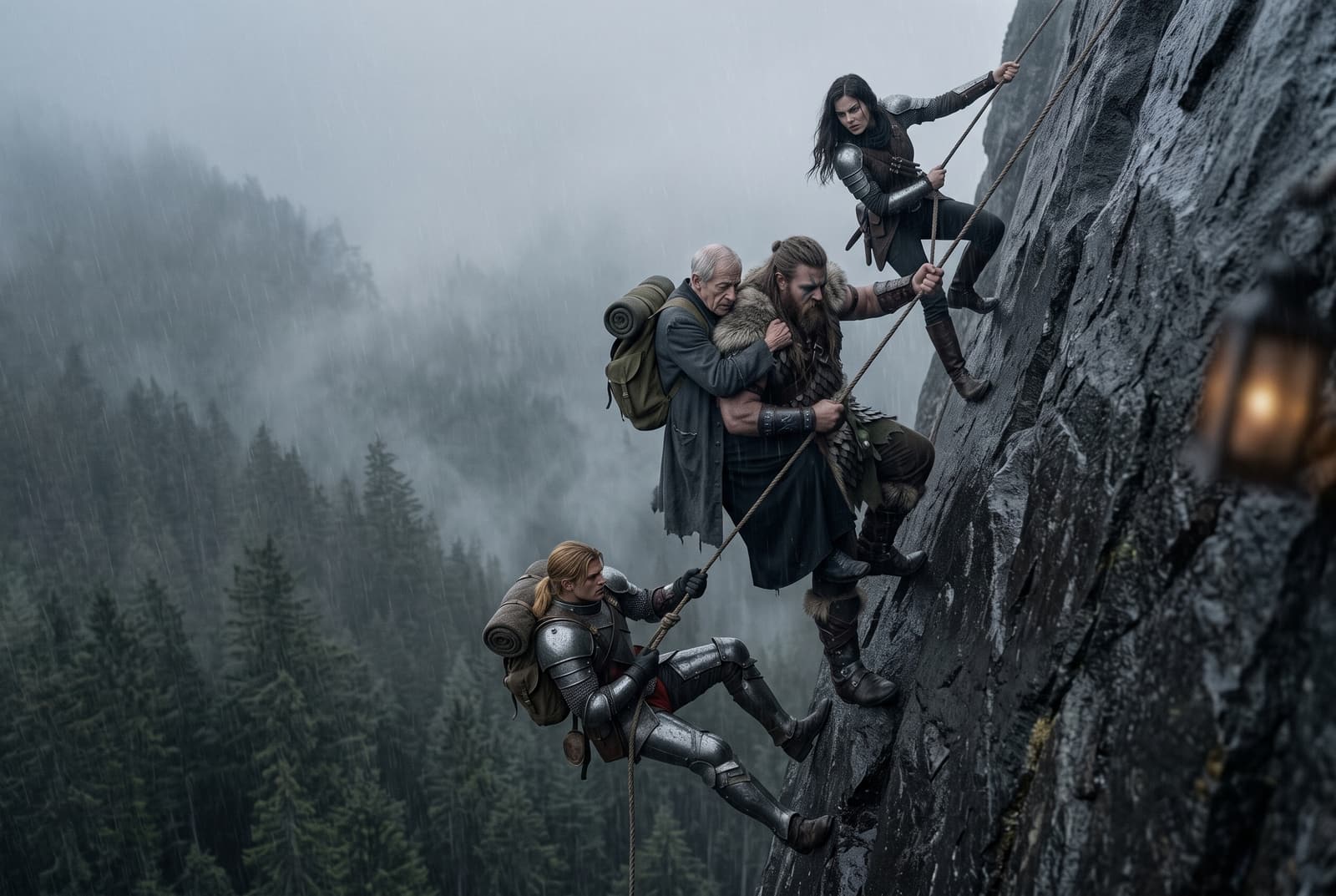
The question was the way down. They could go back through the cave, in the wet, the way they had come. Or, said the Prior — who was agreeable to anything, provided it ended at his own door — they could do what nobody had been bold enough to suggest, and go down the face. It was six hundred feet from the shelf to the forest floor, and no one meant to do it in one go. But there were ledges, and an outcrop fifty feet down where a person could stand, and below that another, and so on, and with ropes the whole of it might take a couple of hours instead of the better part of a day.
Nobody liked it. Nobody could think of a faster way.
Before they went, Marcus asked Edric for a song. Edric said he certainly would, and sang one for the bird, and when he had done he said that she was dear to their hearts and would be missed, and that now that was done, they ought to be on their way. Marcus said quietly that it had been perfect, and that she would have loved it.
Makani would take the Prior. Zara pointed out that the Prior had a pack, and that someone would have to carry it, and that Marcus was in plate and seemed a strong and capable man. Marcus protested that he was an egg man and not a backpack man, and took the pack.
The descent went wrong in the way that descents go wrong, all at once and out of nowhere. Zara’s hand found wet stone where it had expected dry, and fifty feet of mountain went by her in no time at all. However they managed the rest of it, they came out on the forest floor near the mouth of the cave, sore and bruised and quieter than they had been.
They lay about for a while. Then they got up and walked back toward Farthingholt.
The man was still in the chair.
He sat beside the road at the edge of the town, among the debris of the carriage and the dead horse and the dark pool, where he had been when they passed the first time, with his hands in his lap and his sign beside him. Do not speak to me. Do not come close. You will be harmed.
“Everyone,” said Zara, “just keep walking.”
Marcus did not keep walking.
He had been walking with grief since the Clearing, and the sight of a grown man in a chair, hale, with a sign saying he would rather not be bothered, was more than the day had room for. He stepped off the road. He said, loudly, to the man and to the morning, that he thought he had it bad, that he thought he knew what a bad day was, sitting there on his stool. He said a good deal more. Zara took hold of him and tried to hold him back, and then did what she had been wanting to do since the foot of the mountain, and slapped him, quite hard, in the face. Pull yourself together, soldier.
It did not help. Marcus said, to the world generally, that he had said nothing to her when she burned. That he should have said I love you. That he should have said a thousand things, and said nothing at all, and what gave this man the right to say nothing? He collapsed into Zara’s arms. Zara said there, there. Orion’s bear took a step toward the man in the chair, and Orion called it back. Makani, who believed in meeting things with what was to hand, produced a clutch of sunflowers out of the wet air, which nobody had asked for.
The man looked up at last. Straight at Marcus.
“No,” he said. “You fool. Oh, why did you say anything to me?”
Something took shape in front of Marcus.
It began as a thickening of the rain, and had arms before it had a face, and then it had no face at all. A guardsman, you would have said, from some court: black burnished armour in all its parts, pauldrons and gloves and greaves and a closed helm, and nobody inside it. The metal wisped at the edges like a candle left to gutter. It looked at Marcus out of a helm with nothing behind it, and Marcus felt his legs decide, without consulting him, that they were afraid.
He was, as he said afterward, already frightened of a good many things. It was no help.
It struck him twice. One blow missed. The other did not. Zara, with a crossbow in each hand, put a bolt into the helm, and another; one went home and one did not. Edric, who had been standing very still, said he had an idea, and called on a spirit he had not called on before: a small bright thing with a smile that did not suit the day. A trickster. He told it to go after the man in the chair.
The man tried to resist it, and could not.
He put a hand to his head, and said nothing, and went over backward with his chair and lay still. And the guardsman that had been standing over Marcus came apart like breath on a cold morning, and was gone, and the rain fell through the place where it had been.
They stood in it for a while.
Then Marcus, with the whole of his sorrow behind him, proposed that they go through the man’s house. What else was he hiding? Who had he taken possession from? He did not trust him. Zara said she would not be part of robbing a man’s house, and Gilli said neither would she. Orion said that everything the man owned might be cursed. Edric said, with a sort of careful brightness, that he had an idea he meant to follow up, and that it would do no harm to take a quick look round.
It was a poor sort of house. Nothing in it was broken. There was no cellar, nor any sign of one. There were potatoes, and ordinary food. And behind a crack in a corner, where only someone who had really looked would have found it, there was a good piece of parchment: a spell scroll, for Death Ward. As far as anyone could make out it was the best thing the man owned.
The rest they pieced together from what the house told them. He had lived here alone. He had gone out beyond the walls of his own accord, long ago, after word went round that he had made some bargain with the woman Ysolde Karn, and he had not come back.
Somewhere in the course of the search it came out into the open. Zara said they had better ask themselves whether they had just killed an innocent man. Marcus said that he thought he might have rushed that decision, in his sorrow. Gilli said it had been an evil spirit possessing him, and that it was surely the spirit that had killed him in the end. It was not clear whether she believed it. She said so quite firmly.
They buried him, because someone had to, and because they had been told how. At Grayvault they had been told to bury them face down, so that if they dug, they dug the wrong way. Marcus, who had taken the position that the man ought to be cut into a thousand pieces and kept in five separate corners of the house, was overruled. Zara began the grave. Gilli helped. Orion went through the dead man’s pockets for anything that might be put to use, and found two vials in a pocket, which were potions of poison.
“Two,” said Marcus, over the vials, and then, more quietly: “If he meant to kill himself I’d understand one. Why two?”
Nobody had an answer.
“We’re burying him,” said Makani, “so he doesn’t come back for us.”
“We’re burying him,” said Gilli, “because it’s the right thing to do.”
Marcus said it was fine, but that nobody had offered to bury Hippolyta.
Nobody had an answer to that either. There had been nothing to bury.
They had come into Farthingholt past children singing in the lane, a tune that Edric recognized.
Hilda had rooms ready, and the horses were in her stable, and there was a bath if anyone wanted one, which most of them did.
The party divided as it generally did, without a vote. Edric and Makani went to the town hall, in the hope of records. The rest went to the inn.
The town hall had one old door and a sleepy clerk behind it, who looked up and said he did not recognise them, and what could he do for them? Hilda had sent them, said Edric. She had said there were records. There were, said the clerk, and a collection of town history through that door, for those who wanted it. Makani asked whether he knew of a Hollow King. The clerk said he did not. He was not at all sure, he said; perhaps in the folklore; they had a small collection, for educational purposes. Makani asked after anyone with the initials R.A. The clerk knew no R.A. Makani asked about lights that drifted in the sky at night on the mountain, and the clerk said those were wisps and quite dangerous, and that travellers took an interest in them and believed they would be guided safely through the woods, and that from every tale he had heard they would not. Had he ever heard of a wisp leading anyone to a clearing? He had not. It was years since there had been a Clearing. Though now he came to think of it, he had thought he saw a bit of one this morning, very early, when he woke.
Makani asked, last of all, whether there was anything on the valley of Old Ash. There was not much, said the clerk. It would be on the same bookshelf, one up, under Geography and Historical Accounts.
Edric went to the songbooks.
The songbooks had been donated over the years, the clerk told him, and none of them were new. He chose one that was old and fairly handsome. Inside the cover, in a child’s handwriting, as one does in a book that has been given to a child, someone had written two names: Garrick Wend and Lachlan Wend. The book was nursery rhymes, and scribbles in the margins, and music. One of the tunes was a tune he knew. He turned the pages without saying anything. Then he said the names aloud, once, to hear how they sounded.
Makani found nothing on Old Ash worth mentioning, and came back through the stacks to find Edric holding something that was not a book.
The town’s records listed it among the valuables left behind in the Wend residence some fifty years ago. It was a carving: three-dimensional and intricate, with roots, and it went up a little way but was not a full tree. It had runes cut into it, like Makani’s own. It was close enough in shape to Yggdrasil, as Makani knew it, to be unmistakable, though the Tree itself had never been hollowed, and this had been, the whole of it, with places cut into its side. On the bottom there were two initials. L.W.
Makani knew it at once. His tattoos said as much.
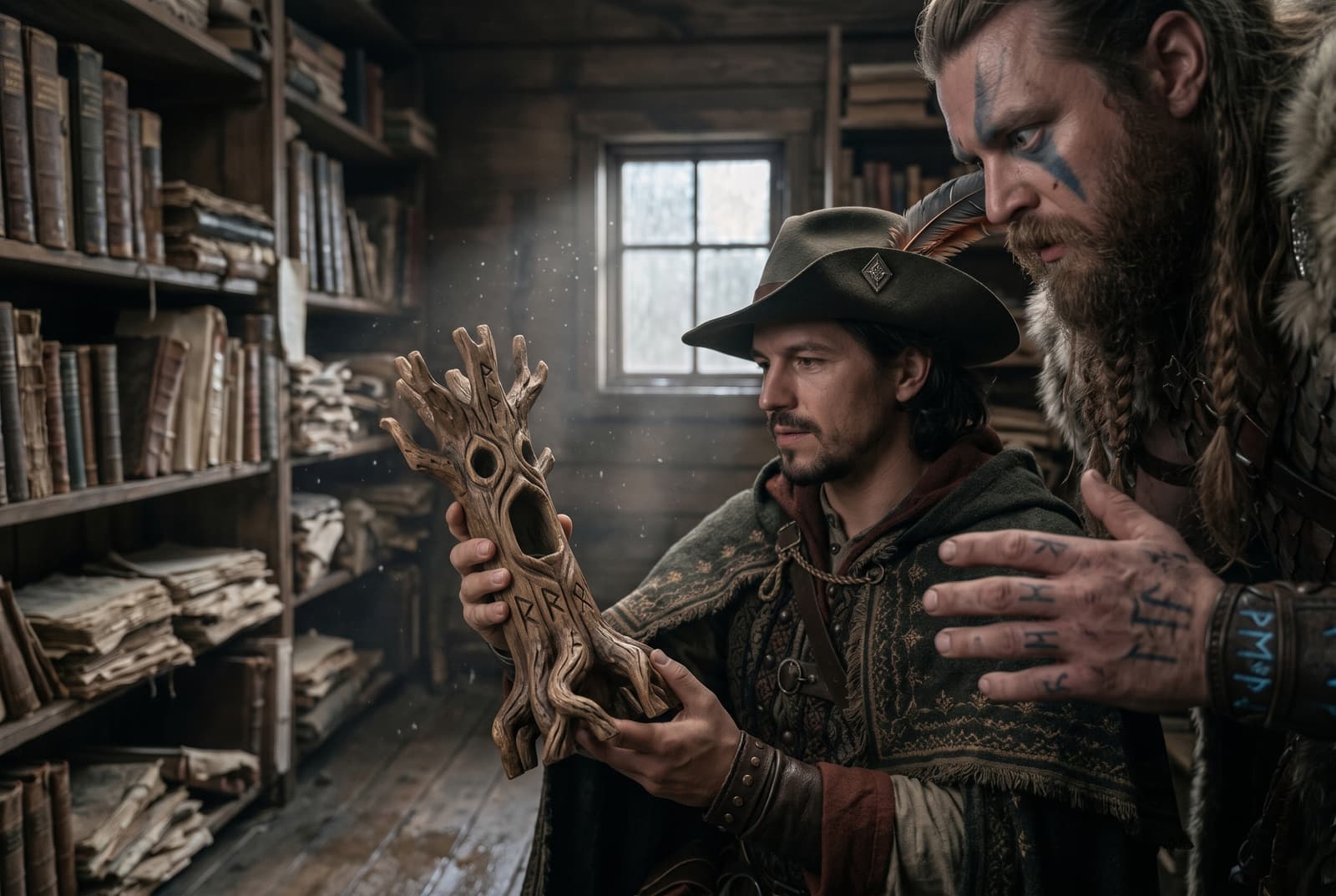
“Hollow trees,” said Edric, to the room. “Given that we’ve been hearing about this Hollow King lately.” He said he was fairly sure he knew whose initials those were, and that perhaps there was a connection. Makani wanted to know why anyone in this town should have the Tree at all.
Neither of them could say.
Edric had a word, too, with the trickster, in a corner where he thought no one would see. He said that he did not know what it thought it was doing, and that it had killed that man, and that he knew it was new here but it would have to slow down. Makani, passing, said it had been pretty efficient, he’d give it that.
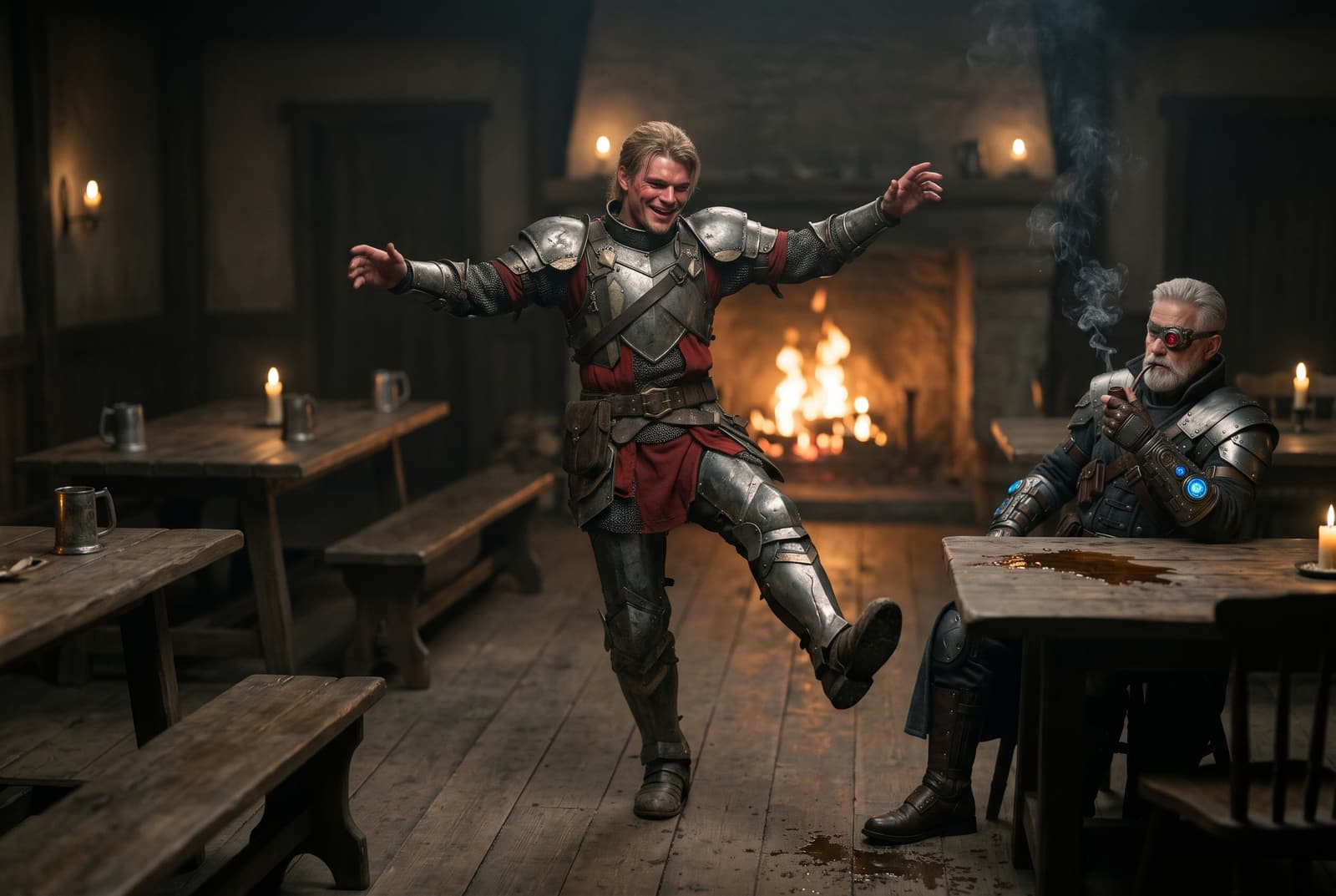
At the inn Marcus was in the common room with a great deal of drink inside him, teaching the room a dance.
It was the dance he had done for the hippogriff. Zara, who had come down from the bath, said that perhaps they ought to put him in a bed. Orion, with his pipe, looked on. The Prior was out on the porch in the cold, with a stranger: an old man, grey-haired, introduced only as a fellow old-timer, with whom he was getting along famously. They were talking about how the town had been in their day. Edric went in to find the Prior a water. He had asked for one.
At some point in the evening Makani said that he had traded the egg to the man at the town hall for a book. Marcus did not take it well. Afterward one of the others said, to Marcus, that she thought they were lying about the egg.
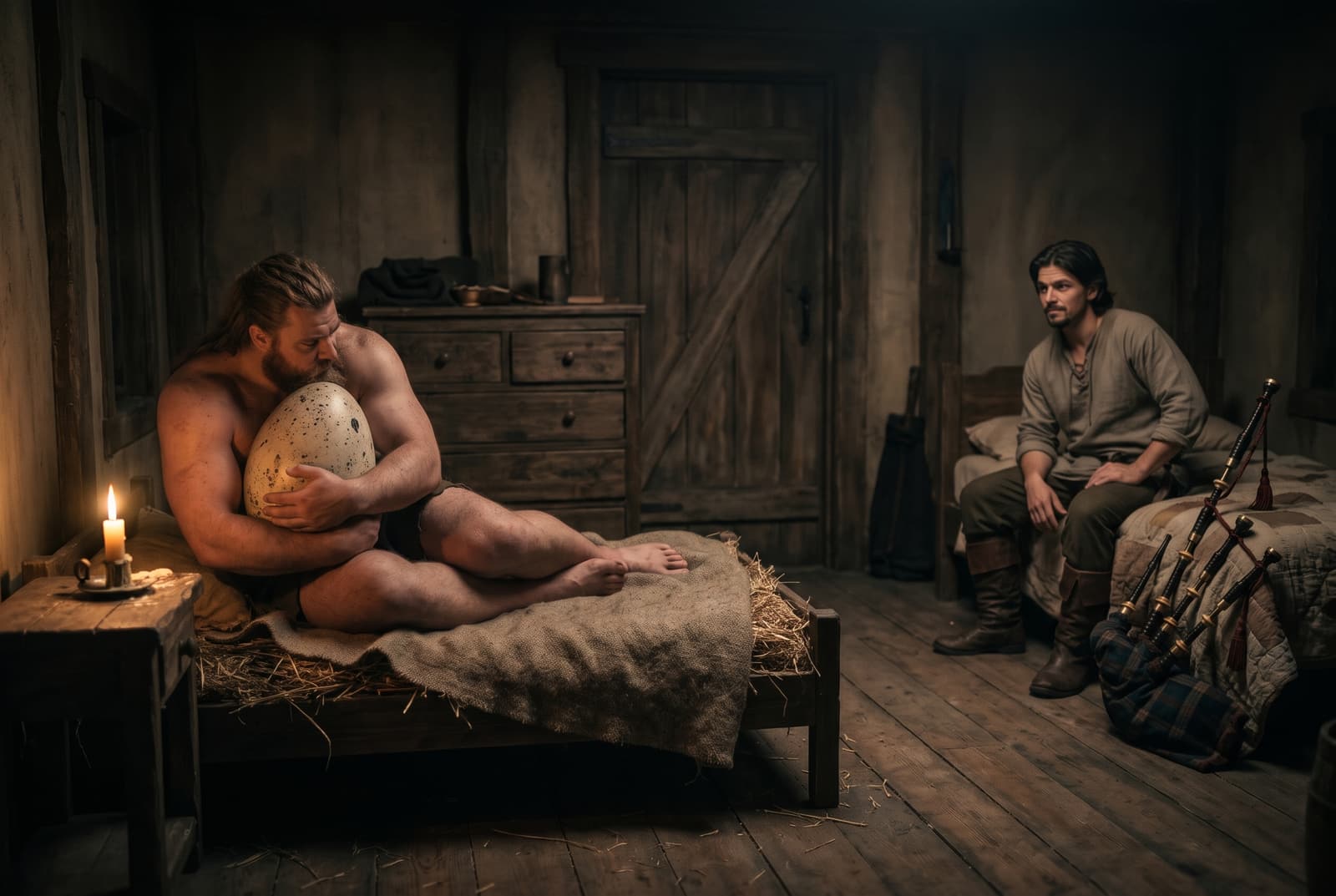
They were. That night Makani took the heaviest piece of furniture in the room and put it across the door, and took off most of his clothes, and curled around the egg in bed to keep it warm. He told Edric he had heard of it done once before, and not to judge. Edric, who was sharing the room, did not.
Zara sat up by the window with her daggers, having salted the sill, and watched the lane.
Marcus was not asleep. He had gone to see the Prior.
He went as quietly as a drunk man in plate can go. The Prior woke and sat up and told him that perhaps he had found the wrong room. Marcus closed the door behind him. “No more lies, old man,” he said, and advanced on him. He wanted to know what the Prior was up to. He wanted to know who he thought he was. He accused him of having let a woman die. The Prior said he did not know what he was talking about.
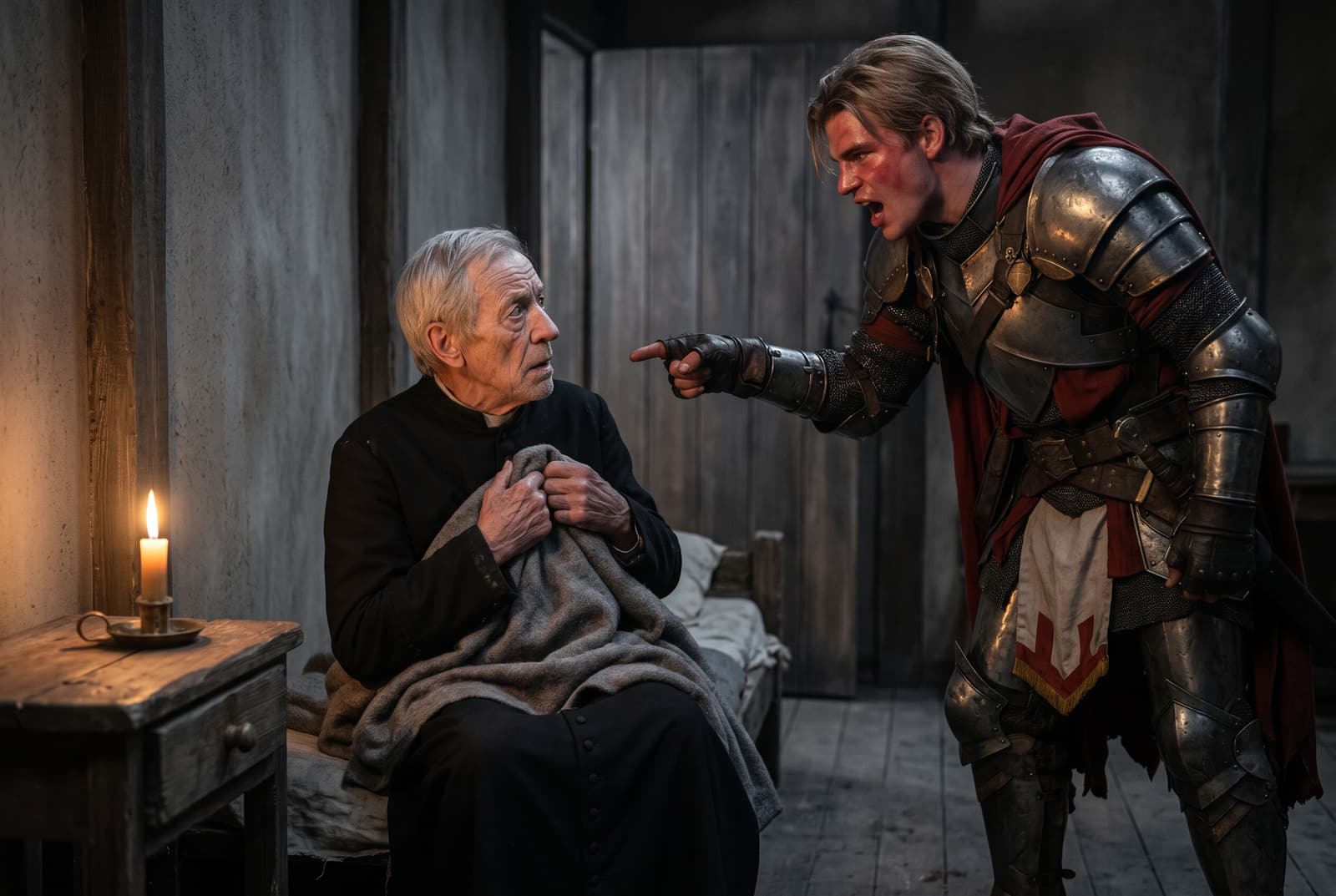
Zara, who had not been asleep either, heard enough of it, and went to find him, and took him back to bed.
In the morning Hilda asked whether they had slept well, and whether the rain had been much of a bother, and whether the boys had managed to do anything about the leaks. Everything was fine, said Zara. Hilda asked if they had any more business in Farthingholt. A few more stops, said Zara. Over breakfast she leaned toward Edric and asked, low, whether they were going to tell her about the man outside.
They would have to tell someone. They agreed that much. They did not agree on what to say. It could be said that an evil spirit had come out of nowhere and killed him, and that they had buried him. Marcus, who was sick on the table, said they ought to tell the truth: that they had thought him evil, and had killed him, and had found out they were wrong. Zara said it had been a spirit.
His name, it turned out, was Ferrell. Hilda was much the older, and remembered him as a young boy. She thanked them for his burying, and they had not expected that.
The party split again before they left. Zara, Gilli and Marcus would see the Prior home to his Priory. Edric, Makani and Orion went back to the town hall, because there was more to read. Edric asked the clerk about the witch, and the music.
It had stopped, the clerk said, about fifty years ago. Before that it had been fairly regular, for a long time, and there had always been the tale: that if you met a witch at the edge of the woods, she would help you. A fairy tale. But the music had come back lately, and he had to say that it was damned odd. He wondered if there might be something in it after all. They had a man out on the road, he said, whom they might have seen; Ferrell, his name was; haunted by something, though he had never seen anything quite like it in all his years. And the boys Edric had been asking about, the Wends: now that he thought of it, that had been about fifty years ago, too. Curious, was it not?
Edric said he thought he knew someone who could ask about that.
There was a man older than the clerk, the clerk said. A Mr. Cordovoy. He did not leave his house much these days, but he lived round the corner, in the red house, and he might remember how things had been.
Makani asked about hippogriffs, and eggs, and anything on the hatching of eggs. The clerk said he had a book on the husbandry of the wild beasts of the valley, and that as they said, if you knew one hippogriff you knew them all; it was the green one, there. Makani asked to borrow it. His word would be enough, said the clerk; they did not have many visitors. Orion asked for anything on mechanical beasts, and divine instruments, and the latest in magical works. There was not much of that here, said the clerk. They had a long history of music and instruments. But the Valley of Kirn, now: a place with money, and a long tradition of fine metalwork, though the weather had made it a harder living than it used to be. He had not been there himself. He had lived in Farthingholt sixty-some years and had not yet seen fit to leave it.
The Priory was as they had left it, but for the door.
Zara, Gilli and Marcus brought the Prior home while the others were still among the town’s books. The carriage stopped at the foot of the track, and the Prior went up ahead of them, light on his feet for an old man and glad to be home. He got to the door and stopped. It stood a hand’s breadth ajar.
“How odd,” said the Prior. “I’m sure I left this locked.”
“What tricks are you pulling on us, old man?” said Marcus. “Are you luring us into a trap?”
“Marcus,” said Gilli.
“I’m only saying it looks suspicious.”
“Let me go first,” said Zara. “Stay here.”
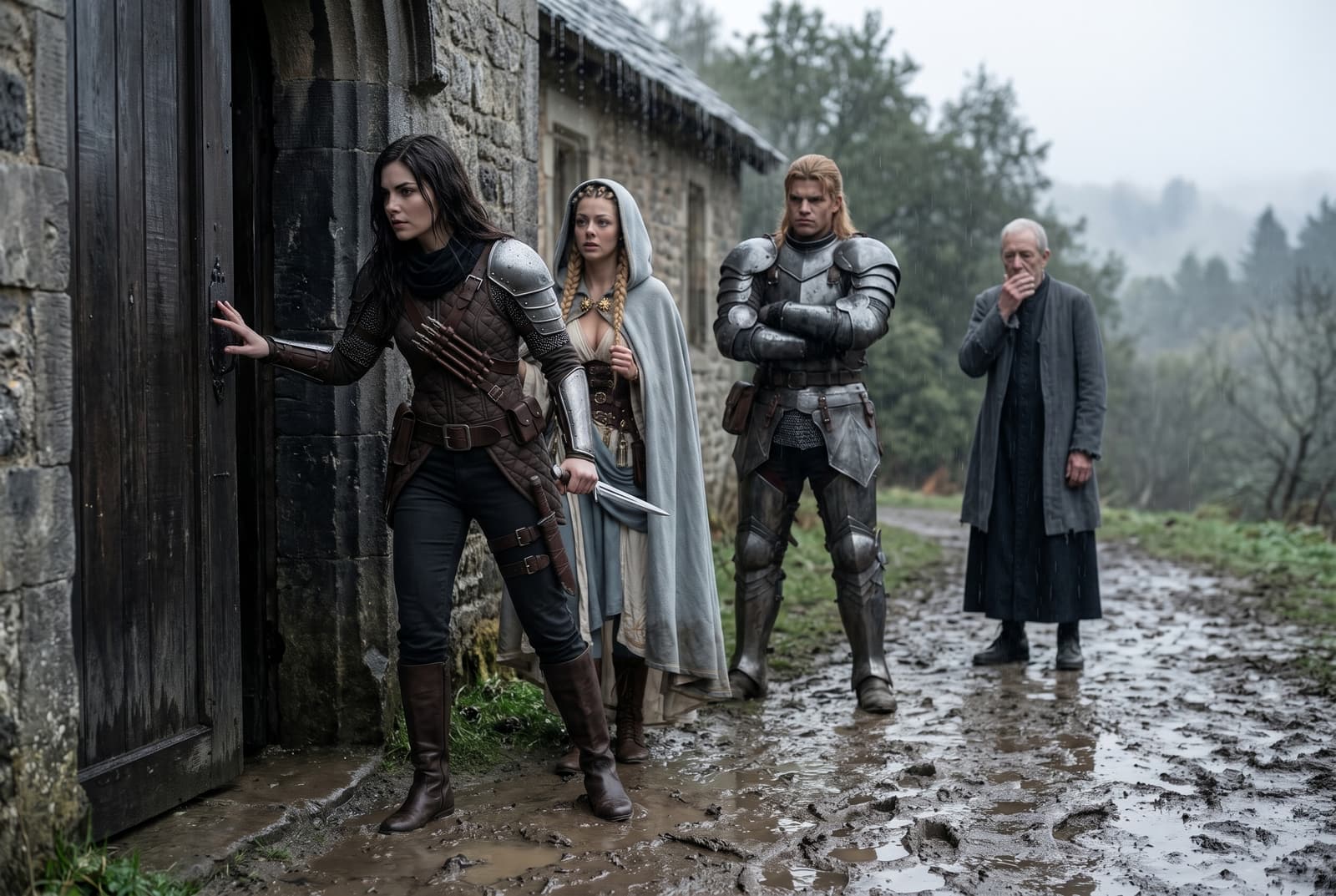
She went in. Nothing was broken. Nothing, as far as she could tell, had been disturbed; the benches stood in order and the flasks in their rows. Gilli went in after her and found nothing either. Marcus said that was exactly what he would expect.
From somewhere in the house they heard the Prior say: Oh. No.
They went to him. He was in the study, by the long bench, with his hand flat on the wood where there had been a book. “The books you gave me,” he said. “The notes on the Clearings. The one your friend Edric gave me. It was right here. It’s gone. Somebody must have taken it.”
Marcus asked whether he had enemies. He did not wait for an answer; he said that he knew it. Gilli asked whether the Prior could still do his work without it. Possibly, said the Prior, but it would take him a long while. It had been such valuable data, and he had not had the time to copy it out.
Zara looked about for something that would say who. She could find nothing. To the best of their reading the Prior was an honest man. Marcus, who had read him poorly, said the man was lying, and that he was so good at it that he might be telling the truth.
“The Prior’s a moron,” said Marcus. “Left his door unlocked.”
Outside, in the wet, there were tracks.
They led away from the Priory through the mud, fresh, and the rain had not yet filled them. Somebody had gone in at a door that should have been locked, taken the Prior’s books, and walked out again.
Who?
And back in Farthingholt, the old question stood where they had left it: what had happened fifty years ago to make the music stop?
Open Threads
- The tracks — fresh in the mud, leading away from the Priory. The Prior’s books, including the one Edric gave him, were taken through a door that should have been locked, with no sign of force. Who took them?
- The music — it stopped about fifty years ago, says the clerk. Children are singing the tune in the lanes again, and Edric recognized it. What happened fifty years ago to make it stop?
- Ferrell — the man in the chair outside Farthingholt, with his sign and a guardsman of black metal that no one could see until someone spoke to him. He is dead, and buried face down. Hilda, much older, remembers him as a young boy. Whatever he made with “the witch,” he took with him.
- Marcus — started the fight, took the hit, and has not stopped grieving the bird. He and Zara are not sure they should have let it end the way it did.
- The trickster — a spirit Edric had not called on before. He sent it at Ferrell. He has had a word with it.
- Garrick and Lachlan Wend — two boys’ names in a donated songbook, the tune Edric knows set down under them. The clerk puts the Wends at about fifty years ago too, the same time the music stopped. Mr. Cordovoy, in the red house, may remember.
- The hollow Yggdrasil — a carving the town records list among the valuables left in the Wend residence about fifty years ago, marked L.W., hollowed from end to end. Makani knows what it is. Edric has a name he thinks goes with the initials.
- The Hollow King — a name the party has been hearing. No one in the town hall knew it.
- The egg — Makani still has it, whatever he told Marcus. He has borrowed a book on the husbandry of the valley’s beasts.
- The scroll — Death Ward, found hidden in Ferrell’s house. Two vials of poison came off his body.
- Orion’s questions — mechanical beasts, divine instruments, and the clerk’s suggestion of the Valley of Kirn.
- Still waiting — the invitation to Vaunt; Ilsabet’s service in Coldhallow; Vosk’s hold in Old Ash; the witch; the song.
Dramatis Personae
- Farthingholt, the town hall: the clerk (unnamed, sixty-odd years in the town); Mr. Cordovoy (named, not met)
- Farthingholt, the inn: an old man with grey hair, introduced only as a fellow old-timer, who spent the evening on the porch with the Prior; the bartender
- Returning, now named: Ferrell (the man at the gate); Hilda
- Named, not met: the hollow-tree carver, L.W.