The road narrowed after Shalegate until the forest stood close enough to touch. Edric could have put a hand out of the carriage window and come away with a fistful of leaves, and now and then, between the trunks, something large and grey kept pace with them for a few seconds and was gone. The drizzle had settled in for the day, and the road stayed firm under the wheels.
They were within an hour of the Tallowbridge Inn, with the light going the colour of dishwater and the bell due, when they met the first company all day that was not on foot.
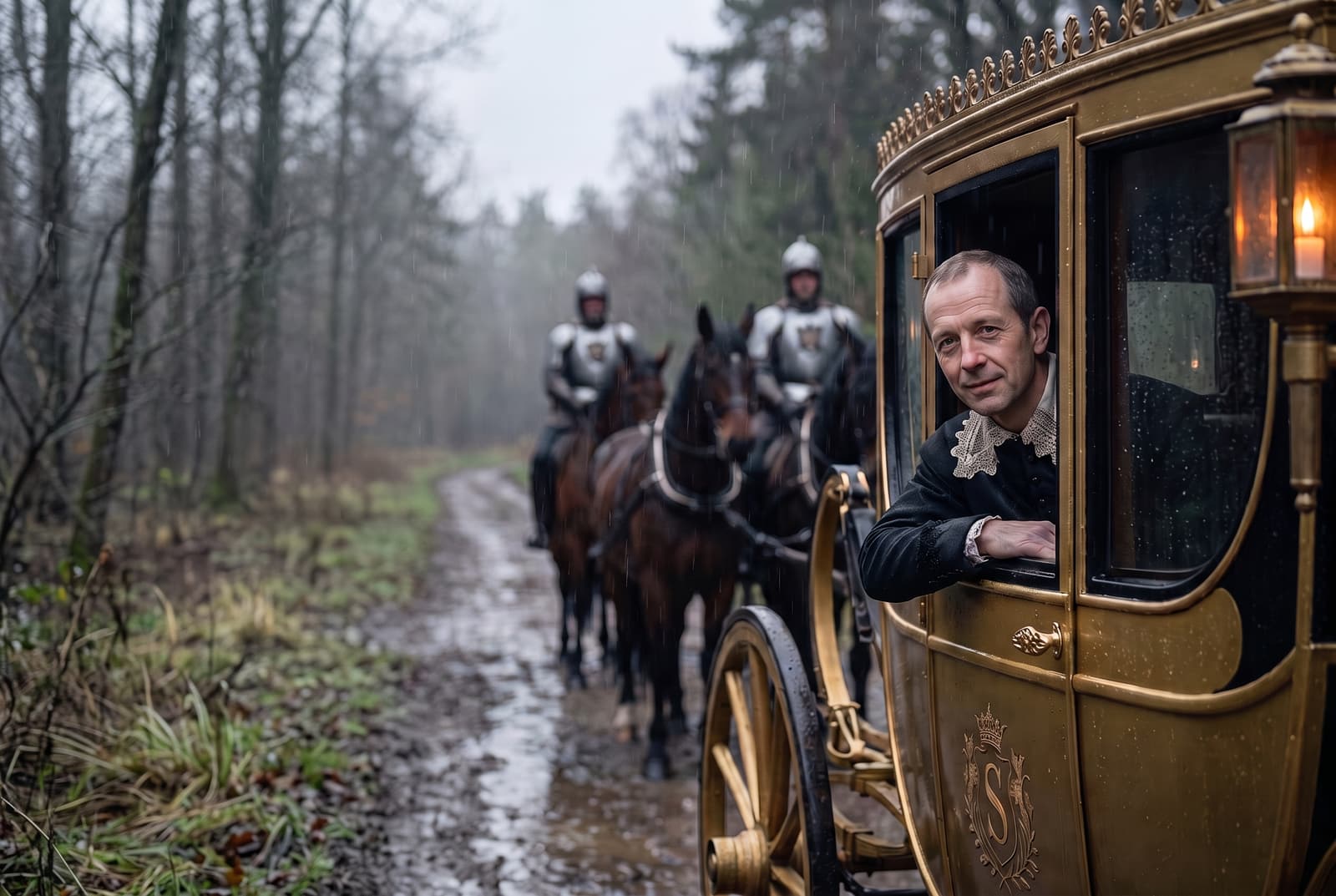
Four matched horses, and behind them a carriage built to be looked at: gilded, lacquered, unmuddied, two people up on the driver’s box and armed men riding escort in armour of one make, every breastplate bearing the same markings. On the carriage door, picked out in gold, a crested S. Edric placed it a moment later: it was the label on the bottle Leon had been so proud of in Millstead.
The riders drew across the road without hurry and without discourtesy, and the carriage came up alongside, and the window came down. The man who leaned out into the rain looked as though it had never occurred to him that rain might apply to him. His hair was neatly kept, his coat the most expensive thing any of them had seen in Karrowmoor, and he was not dressed for a fight. If there had been royalty in these valleys, you might have taken him for it.
Travellers, he said. That’s an interesting carriage. May I ask who you are, and where you’re going?
Zara said it was none of his business, sir. Edric, a half-breath behind her and a good deal smoother, said they were working with the house; their business was their own, but when the lady passed, their instructions had come from her young — grandson, was it? Nephew?
Casimir, said Zara. Young Casimir.
Oh — you’re working with young Casimir, said the man in the window. How splendid.
He gave his name as Emeric Sauvane. He had had word by sending, not two nights since, that the Lady Ilsabet had passed; it had gone on to the Assize and would be common knowledge across Karrowmoor in a few days; he was himself on his way to her service in Coldhallow. Which made it, he confessed, a little odd to meet travellers in the late lady’s own carriage, going the other way, on the eve of it.
He did not wait to be answered. He hoped to see the boy — it had been so many years — and to hear how Coldhallow did and how the estates were kept, and he hoped Casimir would prove a wonderful partner in a venture he had in hand for the valleys. If the party had the boy’s ear, so much the better. He looked up at Makani. And you do look capable. They should come to his estate some evening; he would give them dinner, and get them off the road for an hour, and he rather thought they would find a great many things to discuss.
Makani asked where the estate was, exactly. Ah — you aren’t from Karrowmoor. The Valley of Vaunt. A drive, but if you find yourselves out that way, I would love to host you. Makani said they would very much like to see his vineyards; they had tasted his wine, and it was good. Very good indeed. He would tell his people to expect a party of their rough composition; they would have no trouble at the gates. But please, carry on. I wouldn’t dream of getting in the way of official business.
The escort drew back. One of them, as it did, came up behind the carriage on something that was less a horse than a bull — a rider of Makani’s own size or near it, helmeted, plainly a goliath, dressed like the others and simply larger. He did not look at the party until he passed. Then he looked straight at Makani, and held it, and Zara would afterwards swear that he growled.
Did you see that, Edric? said Makani. That man looked at me funny. Think I should fight him?
The answer, from more than one quarter, was no: it was surely a misunderstanding. Makani allowed that it probably was, and that they could always wait until they got to the estate.
They stopped at Tallowbridge because the other choice was the Priory, off the road in the hills on a track nobody could vouch for, in failing light. No need to chance it, said Edric. The inn was not a town, as Undersluice had been; it was a stable and a house for travellers and not much else, old, patched, a little leaky, fit for its purpose. There was no one to keep the horses. Makani found a boy among the inn’s helpers and put it to him that there was a gold in it for watching two fine animals through the night, and another in the morning if they were groomed and ready. The boy said he would be glad to, and hoped nobody was going to ask him to kill anyone.
The innkeeper was an older man, and said what Karrowmoor innkeepers said. He took just about anybody, because nobody was to be left out in the dark; the going rate was a gold a night; there were no baths, what you saw was what you got, there would be bread in the morning. He asked that nobody come downstairs and open the door in the night. We’re not like the big fancy towns, he said. We look after each other. Two rooms, doors three and four.
Edric stayed to ask questions, in the character of a student of local culture, which was only a little false. The innkeeper said Sallow End had been quiet for sixty-odd years — since Mr. Pell, who’d been heir to the house, disappeared. Creditors came through now and again to look over their investments, and they were not from Sallow End. The people who lived there now were the stubborn, and the odd farmer who’d come to make a claim on the land. A dying land, he thought. Pell Manor was past a bridge that had not borne a carriage in a great many years, nothing like the one they’d come in, and below it a village, Pell’s Rest, where the folk were odd; he would not go up there himself without official business.
If it was strangeness Edric wanted, he wanted Farthingholt. A witch, they said, though some of the people up there would tell you she wasn’t one at all but was there to help the silly old so-and-sos. The tale was that if you had a deep wish, a thing that troubled you badly, you went to the woods and sang a song of some kind, and a lady there would grant it. Not that everyone enjoyed the outcome. A man had once wished that the rain would stop, so his house would at last be dry, and it never rained there again, and his garden died, and his crops, and he had to move his farm back into the rain. Silly stuff, said the innkeeper. Who knows if it’s true.
Edric asked if he knew the song. He did not; he’d never had time for it. There would be songbooks at Farthingholt — quite popular in years gone by — and the town hall at Thornhollow kept good records, if Edric wanted something better than hearsay.
Zara looked at Gilli and said, Another witch. Gilli, who had been tired all evening and had a feeling she could not put a name to, said it might be, and that she needed to pray. She did, first. They slept.
Once more, as they went under, they all heard the organ, very low, beneath the sound of a voice, if you were listening for it. Edric’s spirits were agitated by it, though nothing came of it. In the morning he had the sneaking feeling that something — one of the spirits, or something else — had tuned his bagpipes a half-step sharp, into the key of the organ.
The bread was on the table. The boy had done well by the horses, and Makani paid him for it.
Zara had questions of Edric over the bread, and they were fairly put: where were they going, and why? She would follow him; he need not worry about that. But was there anything she should be doing to back him up? Should she wear the dread helm? Keep her ears open? Witches, she said, were beginning to get to her. Edric said there was no reason to worry; a small matter to see to at Farthingholt, and if they could find anyone who’d seen a man of Bardolph’s description, so much the better. Perhaps even a wish, he said, and laughed.
Gilli said it was not too late to follow Lathander underground and bring light to the darkness, and that she was fairly sure they needn’t worry about witches down there; witches didn’t go underground. Edric said it was dark everywhere, and he did not see why he should go underground to look for more of it.
There were two things to do in Sallow End: the Priory and Farthingholt. The Priory was on the way, or near enough. They went to the Priory.
It lay up a winding stone road in the hillside, slick with rain and dirt but still a road. They passed cottage after cottage, empty and fallen in, abandoned decades ago: once a lively place. At the top stood the Priory itself, in some disrepair but with its roof and its windows and its door, and a stable house beside it with no hay in it and its troughs full of rainwater. Zara looked it over for signs of use and found none. Gilli said that even the most abandoned places deserved a good morning, and knocked.
After a long silence there was clinking behind the door, and then it opened a hand’s breadth and a wizened old man looked round the edge of it. Oh — by Lathander’s light. Are you a dawn greeter?
Indeed I am, said Gilli.
Come in, come in! He carried a very old halberd with Lathander’s crest on it, and he was overjoyed. We don’t get many visitors, you understand. Not up here, not under a sky where we can’t even see his light. Gilli told him they had met a brother of his on the road, the lame man in the stone shed with the book, who had sent them his way, and the old man said that would be Brother Reinhold, and that if he was still out there, he was still doing Lathander’s work.
He was the Prior. He had come to track the Clearings, he said, a very long time ago, and had tracked them ever since. Beyond the front room was a chamber that was less a chapel than a mad scientist’s study: tables and workbenches, a long parchment plotted with dates and times, flasks and powders and tinctures, and on one bench a couple of small pieces of uncharged Clear Light. He asked them, very earnestly, to leave everything where they found it.
The data was all he had, he said, and it was incomplete. This was a large country and he was an old man with a great many gaps. He had looked at it so many years that he could no longer see past it; he believed there was a pattern to the Clearings, and that if he could find it, he might learn what had put the Shroud between Lathander and these people.
Edric asked if he knew the method of capturing Clear Light. The Prior did, and in greater detail than Ysolde had given. He drew the cloth off a crystal and stand very like theirs and walked them through the orientation of the stone and the timing, and added a hymn to Lathander to be sung while it was done, though whether the hymn did anything, he could not say. Edric, in return for the Prior’s teaching Gilli the whole of it, offered Ysolde’s journal: her own record of the Clearings, kept for years. The Prior opened it and turned a few pages, and the delight went across his face like sunrise. Sixty, seventy years of it. Where did you find this? From a woman in Coldhallow, said Edric, who had had the same pursuit and was no longer with them, and who would have wanted her lifetime of work not to go to waste.
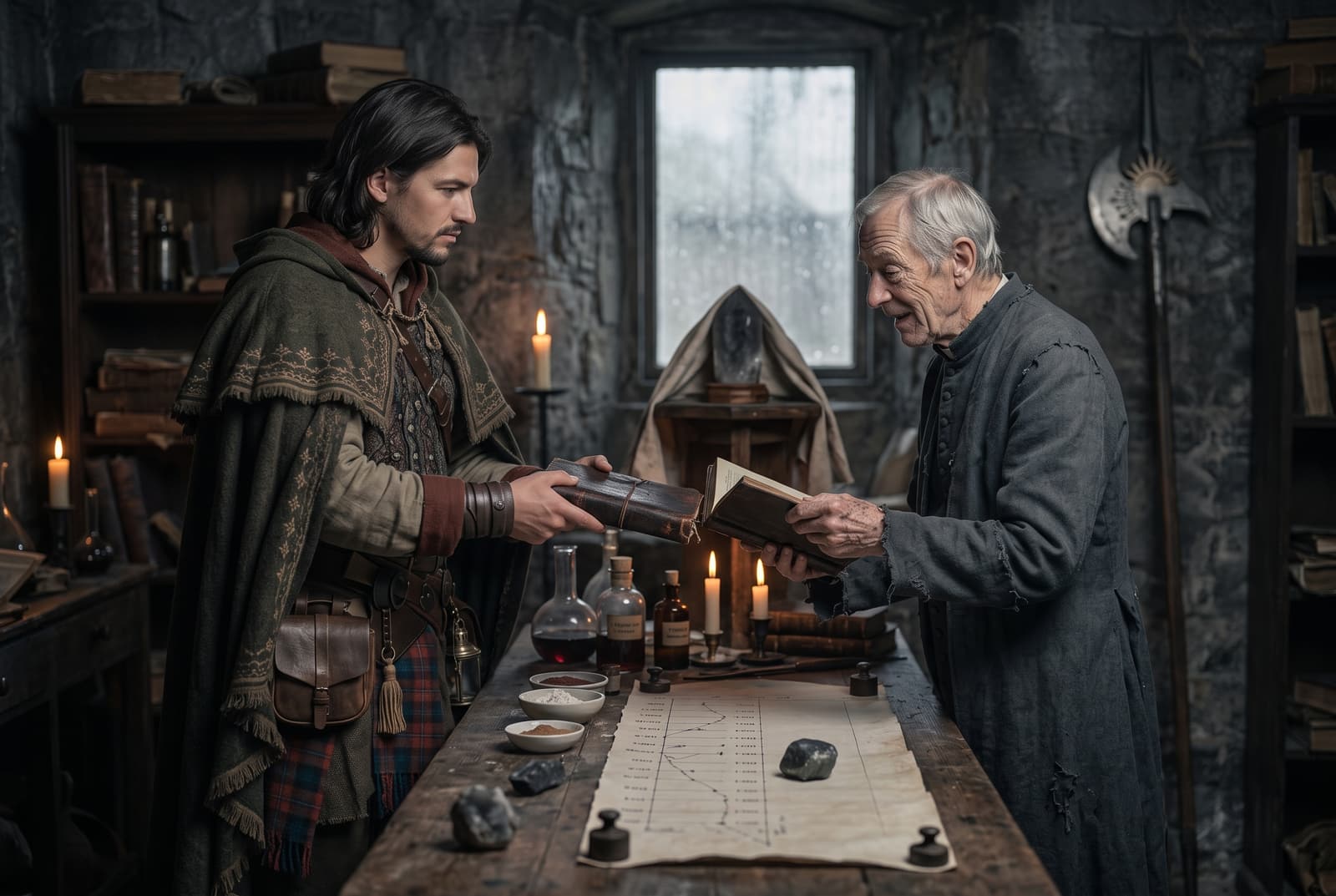
Going through the rest of their papers, the Prior found the note about the Umbral Darkness, and read it through, and said goodness me, more quietly.
Now. I have theorised, he said, and he was a little embarrassed. The same power in the hills’ silver that caught daylight and gave it back on command: might it not be turned the other way, used as a reagent to make darkness? In great enough quantity, if such a thing were possible — it would be preposterous — one might shroud a farm. A small town. Something larger. What if that is what hangs over our heads? Where one would get that much Clear Light, or that much arcane power — I know. Preposterous. But he thought it was what the note referred to. He would need time with it. A resource for Lathander’s good, of course.
Then he asked someone to hold the end of a long parchment, and Edric did. It was the same data, he said, that they had seen — but laid out on the map. Do you see the pattern? They did not. No, I suppose not. He drew his lines and put numbers by them, and set his finger down twice. With the journal’s data he could say with some confidence that a Clearing would come within a couple of days; his trouble had always been where. There, or there.
The first lay in a cave system on the far side of the valley, which he believed was the only way to it; no one could go over the peaks. The second was not in Sallow End at all, but in Old Ash. They had lost a brother and a sister there, years ago. He had heard the people were uncharitable and did not care for Lathander’s word, and he did not expect to get far into that valley without help. But perhaps you, dawn greeter, and your friends, are just the people. I am only an old man. If the Clearing came, he could charge the Clear Light he had, and they were welcome to it. And with some of it he might try to learn what the Umbral Darkness was.
Funny you should mention caves, said Gilli. Lathander has sent me visions of these caves for many nights now. She turned to Edric. He has answered, Edric. Please. Please, please.
Edric asked how sure the Prior was of the two places, and how they would know which. The Prior could not say; only that it would be one or the other. Old Ash was a day and a half off, give or take, three valleys over. Zara said she was not fond of caves but that it might be their only chance. Edric said that as little as he liked caves he liked Old Ash less, and this seemed a fair compromise. He did say, because somebody had to: we all know what’s in caves. Dead things. A man they had spent an afternoon digging beside, who was in there somewhere still. Poor Thaddeus, said Zara.
If it gets too hairy, said Makani, we turn around and walk out. Nothing says we can’t. But we should look.
The Prior began to pack. A very large rucksack: books, tomes, pens, pencils, focusing crystals, reagents. He was frail and not quick, and he was full of joy and fervour for Lathander. He asked, as a favour, whether they would see him there and back alive. They said they would.
Farthingholt lay down the valley. The country got poorer as they went: more buildings than there were families to fill them. The town had a small wall around its middle, built, you would have said, by someone who had decided its outskirts weren’t worth the stone, and outside that wall was something that stopped the conversation in the carriage.
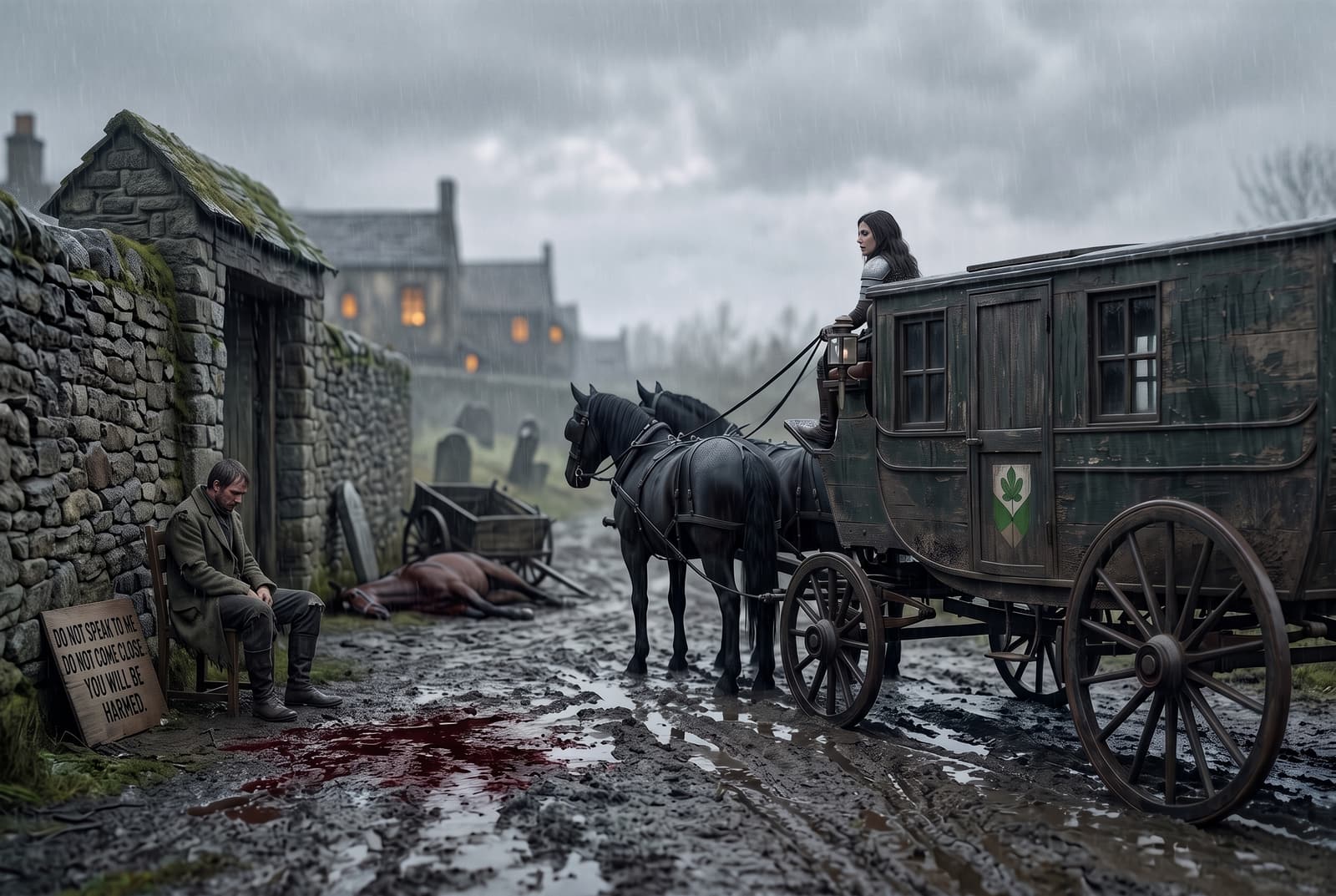
A man sat in a chair beside the gate. He did not move. The ground around him and across the road was a deep dark pool of blood, and in it were pieces — an animal, or some animals, and maybe some that weren’t — and scattered goods, and a dead horse, and a carriage pushed off the road and left. A sign, in big letters: Do not speak to me. Do not come close. You will be harmed.
That was all it said. Zara steered the carriage straight on by him with her eyes to the left. Edric said he did not know the local customs, but he suspected they were better off keeping an open mind and moving; nobody argued.
Beyond a graveyard many generations old was the town, and it was not thriving. No crop, no grazing, no vineyard; paddocks gone to weed. The people who were out looked at them with interest and no alarm, as though visitors were a thing they had mostly stopped expecting.
A woman came over and asked what brought a young company like theirs all the way to Farthingholt. She kept an inn, she said, though she had not had a guest in a long while; would they be staying? Not this time, said Edric — only the horses, for a day or so; they were lodging with a friend nearby who couldn’t take a carriage. That was all right. A gold for the night. My name is Hilda.
Edric had a few questions. He was a musician, he said, and not long ago he had come across the most captivating piece of music, and when he went looking for where it came from, the trail had led here. He did not play it. Oh, God. I’m not playing that again. But he knew the words, from a book at Grayvault:
Sleep, my dear and bar the door
the dark won’t cross what’s asked before
Sing it soft and sing it true
and nothing sung will come for you
Oh, yes, said Hilda. Yes, I know that song. She had sung it to her own babies, now grown. Everyone in the town knew it, in a dozen versions; there had been good musicians here once, long ago, an artistic town. But Edric was not from here, and she would like to know where he had heard it.
From records at Grayvault, he said, which had pointed this way. And then, because it was true and she was watching his face: he thought he had heard it himself, the night before.
Well, said Hilda. Long ago — before she was a girl, even — they would hear it play across the fields at night, whoever it was. The words were put to it afterwards. She did not know where it came from, and they dared not go looking; perhaps adventurers were braver. It had been silent most of her life, until some months ago, when it started again. And now here you are, an adventurer from outside Karrowmoor, asking after it. It’s damned strange.
Nobody knew who played it? Edric asked. It was said there was a witch in the woods who granted wishes, said Hilda, and they believed it was she who played. She had never gone looking. If he liked, she would have the town hall’s records opened for him — she kept those too, though nobody ever asked — and there were old songbooks among them a musician might like. She would warm the inn and dust the cobwebs and see the lamps oiled. Edric said he could not thank her enough. They would be back in a day, to stay, and to read.
He asked about the man at the gate. Ferrell, said Hilda. Had he seen him? A horrid, ghastly thing. Ferrell had been a good man, or was, and was haunted by something. The few of them who had tried to find out what had all died. He had taken it on himself to move out beyond the wall and bear his curse alone, and they understood he had made some arrangement with the witch. She would not recommend speaking to him. But she worried he would starve himself, sitting there, day in and day out; if they could help him, she would be in their debt, and she begged them not to be hurt.
Could they speak to him — from a distance, perhaps, by a sign? Dear me, I wouldn’t try. But you’re a good deal stronger than I.
Zara said that if they saw the witch, they might ask her. And that was when Hilda said the thing she had been meaning to say since they had mentioned the song.
If you see the witch, do not make any bargains. It never ends well. She brings bad tidings and sorrow. Don’t go looking for her. She did not know where the witch was; she had never met her and could not say how Ferrell had. It was said that in great need you went to the edge of the woods and hummed the tune Edric knew, and she would come with an offer. I cannot recommend this strongly enough. Do not seek her.
Edric said that as he stood there, he would not go seeking the witch. Hilda took him at his word.
They left the horses and the carriage in Hilda’s stable, for a gold, and set out on foot with the Prior leading; it was midday or near it.
It was a moderate hike up the valley wall. Some way up the Prior stopped and pointed to a flat rocky outcrop far above them, with no peak on it, and said there; that is where we need to be. It looked an aggressively difficult climb, and a long way. Off to the left of it was the mouth of a dark cave. His records said there was a path inside that went up and round to the back of the outcrop, and that was precisely where, in a day or two, they would see a Clearing. That, and getting an old man with a heavy pack and bad knees up there with them, was the whole of the plan.
The mouth was narrow. They sorted themselves: Makani in front, Gilli behind him, the Prior third where he could be watched, Edric next, and Zara last. Gilli put a light on Makani’s greatclub, which pleased him. Edric carried the lantern.
The cave narrowed at once into a tight corridor, stalagmites standing in it like a mouthful of teeth from years of dripping. Old caving gear lay abandoned there a long time since; it had been explored once. Makani, in front, noticed the slick of water on the rock and the signs of its coming down, and became very aware that he could fall at any moment, and slowed. That was what kept him from the pit.
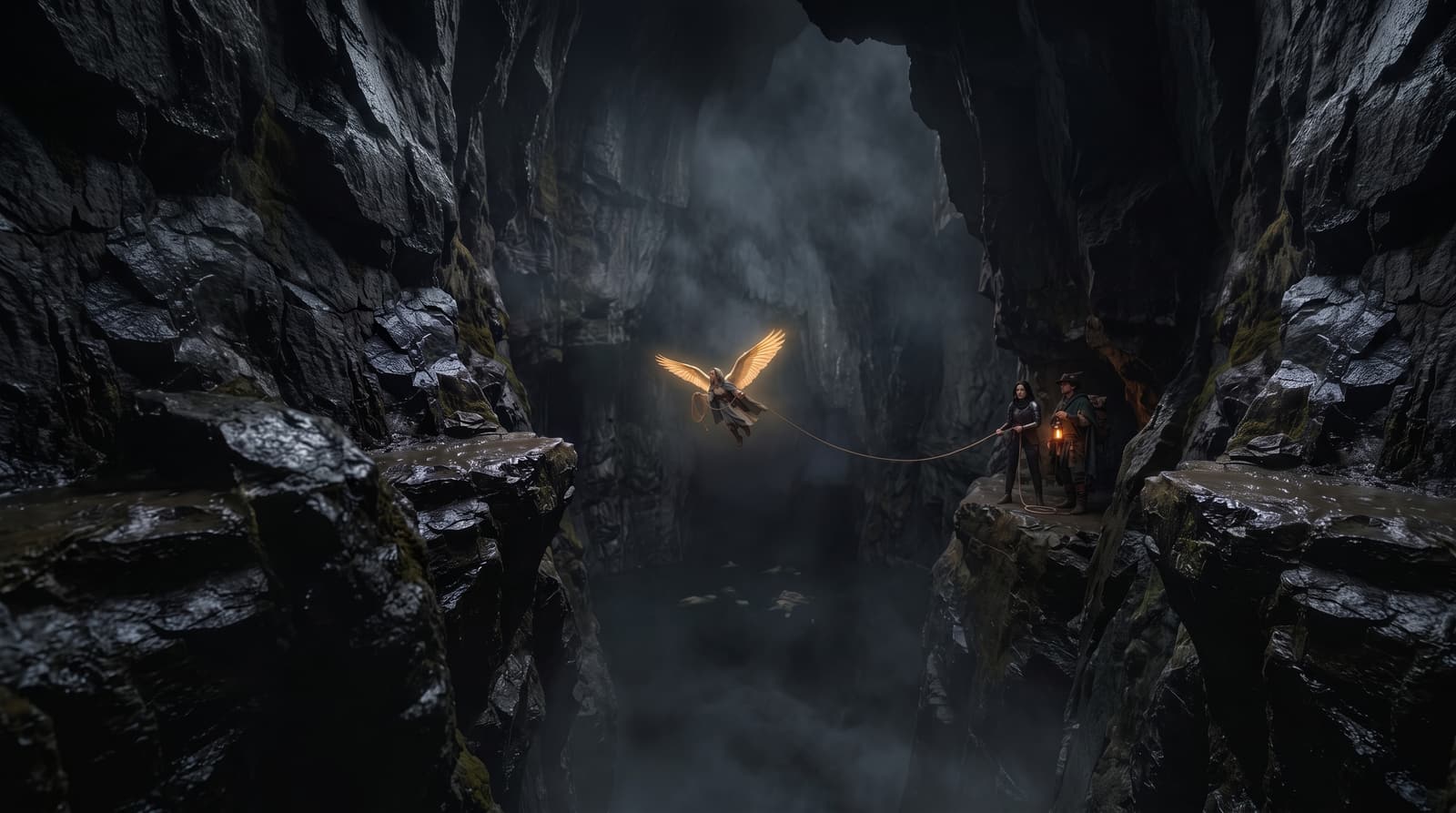
The path ended at an edge that was hard to see for the angle of the light. You went down to climb up the other side, and what lay at the bottom was water: not a room of it, but a good deal, black, with the carcasses of a couple of animals floating on it.
Zara had a rope. Gilli, who had been born with a little of heaven in her, spent a share of it on wings and flew the end of it across and found something to tie it to. The Prior went over first, with a murmur from Edric that was half encouragement and half a spell, and Makani took the old man’s rucksack off him, gladly. Edric went next, and was glad to be on the other side; as he crossed he had looked down and thought the water was moving. Zara went over in two quick hops like a soldier at drill. Makani came last with the Prior’s pack on his back and fought the rope the whole way, and made it. Nobody went in.
On the far side the rock came down to another pool, much smaller, lapping at their boots, and the only way on was under the stone in front. Makani asked if anything lived in it. Zara got down for a closer look and saw only cold clear water, and light passing beneath the rock. There was a strong smell from somewhere that nobody could place and nobody liked. Makani offered to go first, being able to take a couple more hits. Zara said she did not mind scouting; somebody had to see how far it went and come back and tell the others. Gilli lit her dagger for her. Zara said she would rather have it on a dagger in her hand than on a helmet underwater. She dived.
She was gone some time. She surfaced on a ledge in a chamber where the smell was far worse, and it was gas, thick enough to burn her eyes; she shook the worst of it off and went back under with her senses about her and swam for the next ledge, and came up in another cave, with a path leading up and round some rocks. She swam back and told them the way. Hold your breath, she said, and it stinks.

They all went through. The Prior, whom nobody had thought would manage it, managed it. The gas caught Gilli full in the face on the way, enough to hurt, and streaming-eyed they all got to the other side.
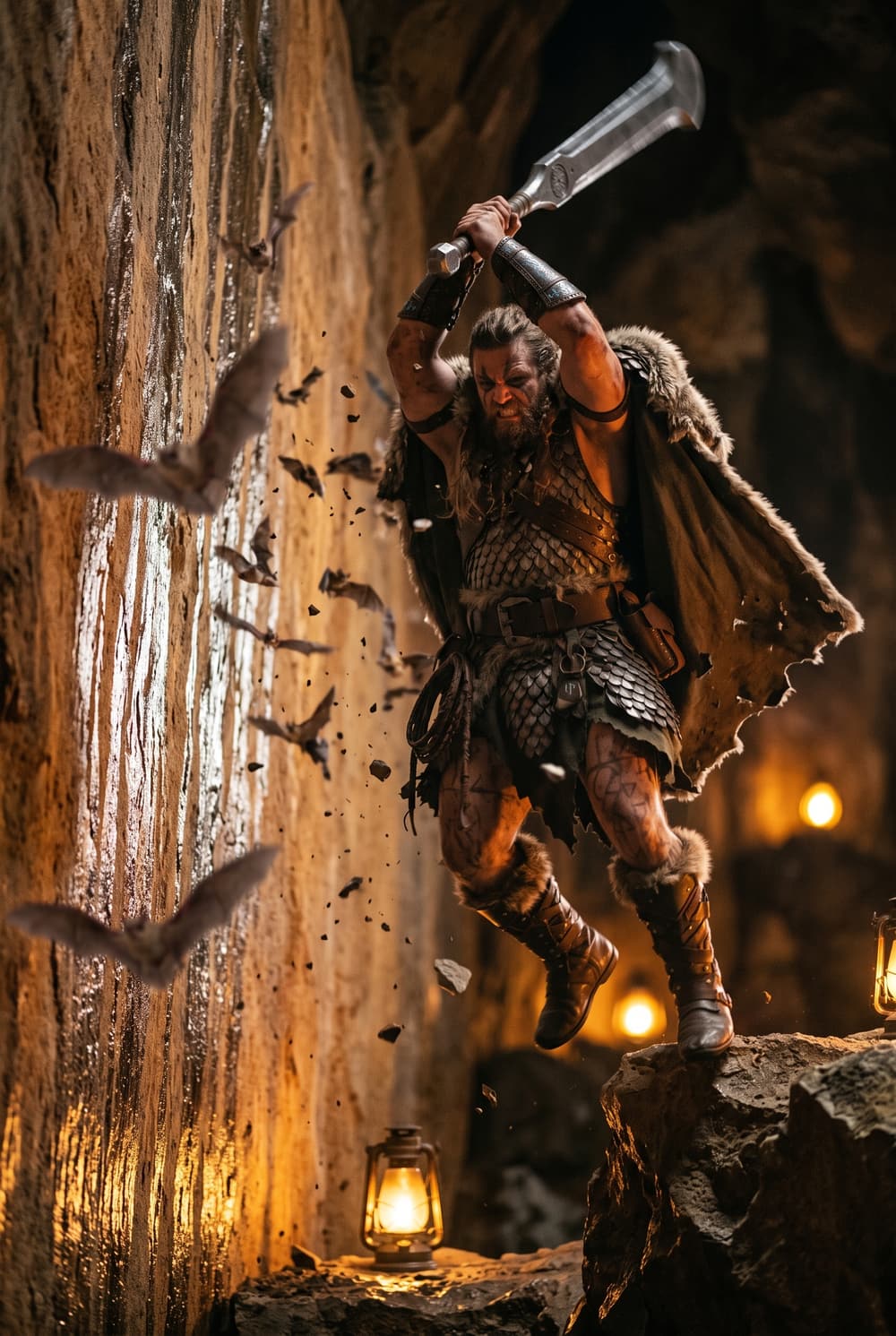
Climbing again. Their legs hurt. The cave got wider above them until the roof was lost, and over on one side a crowd of small bats hung together in one place, a few of them fluttering. Edric asked why there and not elsewhere. The wall there, Makani found when he put a hand to it, was a little warmer than the rest, and running through it were silver streaks that looked a great deal like the Clear Light they had seen before. The bats were clinging to it for warmth.
Promising, said somebody.
They had not brought tools. Makani had a great club made of metal, which was not the most efficient way to mine, but he said he would try if they wanted. Edric said that if they had a big piece, and they were in the right place, and this wasn’t some backhanded attempt to get them into a cave to die — I’m cave-averse — he would be glad if Makani tried for a big piece. Edric and Zara went to hide behind a stalagmite; Zara covered her head. Don’t hit the bats, said Gilli.
The Prior was at Makani’s shoulder, showing him where: You see the striation here? We want this piece. Oh, I wish we had a pick. Makani put his strength into it, and called up the rage to do it. The rock splintered and fell, and the old man was on it before it landed, picking through the scree. One Shard of Clear Light and one Ember: small, dark, uncharged things. The rest was rock. Gilli said she would carry them; they weighed next to nothing.
Makani wondered what would happen if Gilli cast light on one of them. Gilli, who had been given a new piece of light that week, thought it might serve. It would not; it seemed the stones wanted a true Clearing, and nothing less.
The vein went on up the wall, to where the bats were. If anyone could get up there and clear them, there was more, and Makani had his boots. He sprang, club first, and came away with another Shard. The bats went wild, pouring up the cavern in a roar, and the party went after them, because somebody said — quite rightly — that they must be going somewhere.
They were. Up through a couple of boulder-falls, over loose stone, there was a grey light that was not lamplight: rainy daylight, the last of it. They came out on a rocky outcrop, with the valley of Sallow End laid out below and the road they had walked that morning. It was getting darker.
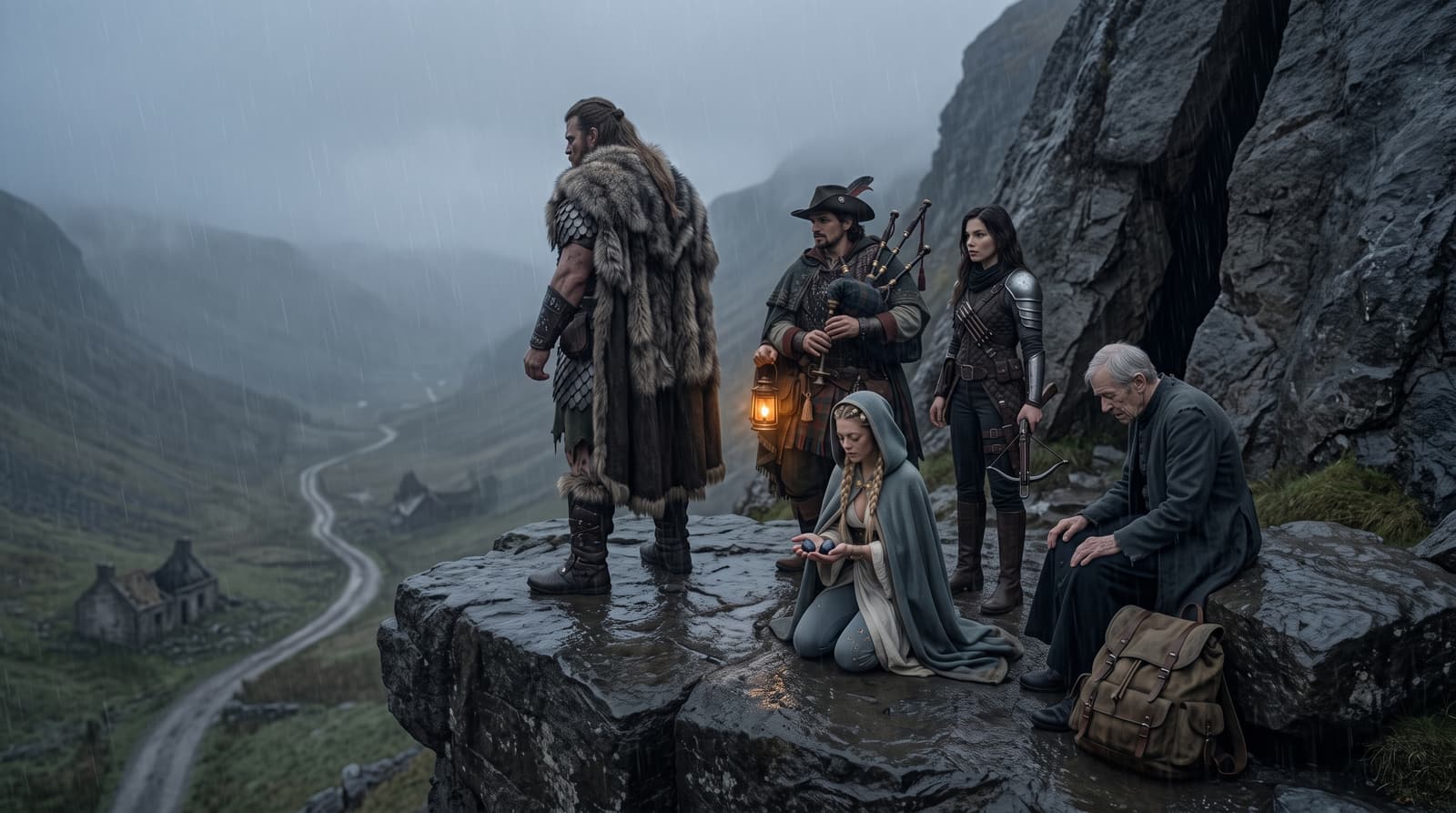
Two Shards and an Ember in Gilli’s keeping, uncharged, and a Clearing perhaps a day or two away, here or three valleys over. The Prior, who had to be kept alive, sat down heavily on a stone. Farthingholt waited below with a lamp trimmed. Night came on in the rain.
Open Threads
- The gilded carriage — a man who gave his name as Emeric Sauvane, the vintner whose name and wine they have known since Millstead, stopped them on the road. He invited them to his estate in the Valley of Vaunt and said he would tell his people to expect them. He is on his way to Ilsabet’s service in Coldhallow. He asked after Casimir. Whether the party will go is not decided.
- The goliath rider — helmeted, on something like a bull, in the escort. He looked at Makani and did not look away.
- The Prior’s pattern — a Clearing within a day or two, at the cave system’s far side or in Old Ash. Which, he cannot tell. The party chose the cave. They are on the outcrop now.
- Umbral Darkness — the Prior’s half-embarrassed theory that Clear Light turned the other way could make a darkness big enough to shroud a farm, a town — or more. He wants time with the note.
- Ysolde’s journal — now with the Prior, who has sixty or seventy years of Clearings to fit to his map.
- Two Shards and an Ember — uncharged, and Gilli carries them. They will need a real Clearing.
- The organ, again — heard at the Tallowbridge Inn by all of them. Edric’s bagpipes were tuned half a step up to its key in the night. Hilda says the tune was silent most of her life and began again a few months ago.
- Hilda’s records — the town hall at Farthingholt, to be opened and lamplit, with songbooks. Edric told her they would be back within a day.
- Edric’s promise — that he would not go seeking the witch.
- Ferrell — at the gate, in a chair, in a pool of blood, with a sign. He made an arrangement with the witch. Nobody has spoken to him.
- Pell Manor and Pell’s Rest — the heir, Mr. Pell, who disappeared sixty-odd years ago; a bridge that won’t bear a carriage; odd folk.
- Old Ash — where the Prior lost a brother and a sister, and the second place on his map.
Dramatis Personae
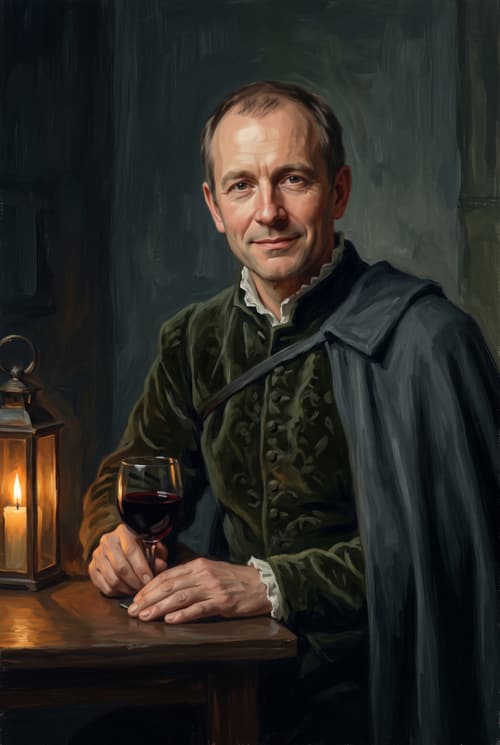
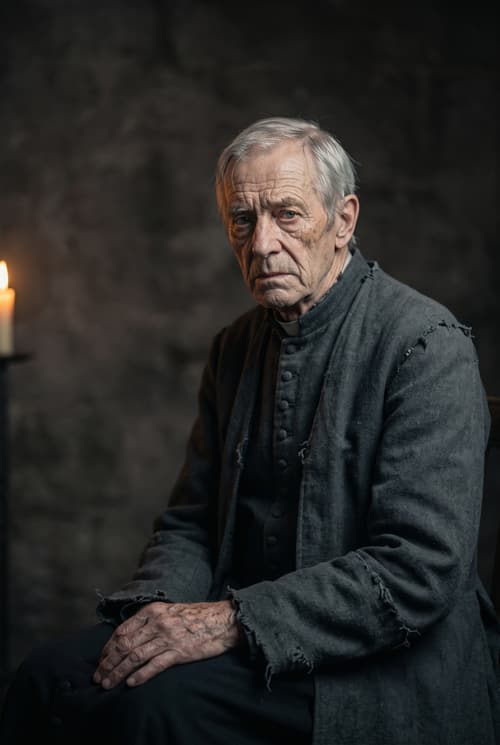
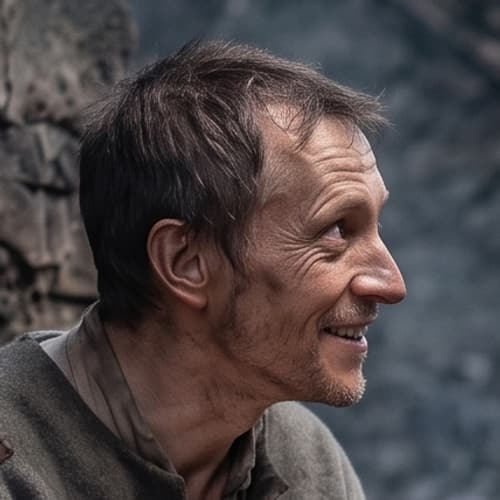
Also met: Hilda, innkeeper at Farthingholt and keeper of the town hall’s records; Ferrell, seen in his chair at the gate and not spoken to; the innkeeper at the Tallowbridge Inn and the boy who kept the horses; Emeric Sauvane’s armed escort in matched armour, and a very large helmeted rider on a bull-like mount.
Named, not yet met: the witch in the woods; Mr. Pell.